

Back

A small dog sits on a red couch, looking towards the camera with its head tilted.](https://cdn.prod.website-files.com/663379b068243e81cd1bd4fd/667c15c9f851bf3b02bc3982_Overview.svg)


Back
industry


Back


Back


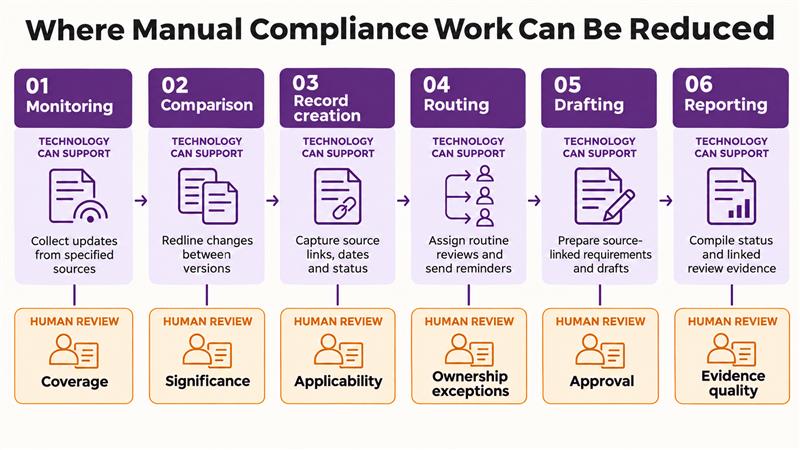
Six jobs eat the most time and give the least back. Checking the same regulatory sources by hand, comparing document versions line by line, typing one update into several trackers, forwarding alerts and chasing people for status, drafting requirements from a blank page, and rebuilding the audit trail every time someone asks for it. All six can be automated once your sources, business scope, owners, and review rules are clear. Legal interpretation, uncertain applicability calls, and sign-off on policies and controls stay with people.
Most compliance teams can describe it without thinking. An analyst opens six state agency websites every morning and scrolls for anything new. When something turns up, she downloads it, pastes the key points into a spreadsheet, and emails the link to whoever she thinks owns it. A colleague copies the same items into a project tool. On Thursday afternoon the two of them sit down to reconcile their lists, because the lists never quite match.
By then the spreadsheet is called something like RCM_tracking_final_v3_updated_final.xlsx.
Bloomberg Regology’s Ultimate Regulatory Change Management Q & A guide uses that exact file name to describe why spreadsheets break down, and most readers will recognize it.
None of that work answers the question leadership cares about, which is what the change means for the business. It just gets the team to the starting line.
Start with tasks that have predictable inputs, clear rules, and outputs someone can check. Here are the six that come up most.
Picture a state banking department that moves its rulemaking page to a new URL. The bookmark still loads, just to an old page. Nobody notices for three weeks, because a quiet page looks the same as a page with no news.
The issue isn’t effort alone. It’s that gaps in coverage are often invisible until someone discovers a missed obligation.
Replace it with monitoring built on a defined source list tied to your business. Keep the source link and collection date with every update. Then give one person the job of checking coverage, especially when the business enters a new state, so an empty alert queue gets questioned instead of trusted.
The same goes for proposals and bills. Bloomberg Regology’s horizon scanning blog notes that teams can get hundreds of alerts about proposed legislation a month, and only around 5% ever becomes a law. Most teams can manage that volume for a few weeks, but maintaining the same level of consistency quarter after quarter becomes difficult.
Two PDFs sit open side by side while someone scrolls through both documents looking for differences that may be only a few words long. It’s slow, and it’s easy to miss a single changed clause in a definition.
An amended rule should arrive as a redline. What changed, marked up against the prior text, with both versions kept so that the reviewer can check. The reviewer still reads the surrounding section, because one word added to the definition of “customer” can matter more than a rewritten paragraph.
The redline may tell you what changed but deciding what it means for the business is still someone’s job.
The spreadsheet, the GRC platform, and the project tool. Every update is most likely entered three times by two people, and then reconciled on Thursday.
Pick one system of record for the source, requirement, owner, and status, and sync from there.
Before you connect anything, agree on which system owns which field and what happens when two records disagree, otherwise you’ve automated predictable arguments.
If your team runs Archer, Regology’s post on integrating with GRC platforms like Archer shows how that connection works.
An alert goes to the privacy mailbox but the person who used to own privacy reviews moved to another team in June. So nobody replies, nobody escalates, and the alert sits.
Routing rules and reminders fix this where ownership is clear. A state licensing update probably has one obvious reviewer. A change touching both privacy and product operations needs a named coordinator to decide who takes it.
Two things to watch. Track assignment, acknowledgment, and completion separately, because a notification going out isn’t a review getting done. And don’t route your way out of a noise problem. Regology’s applicability article uses the example of a U.S. crypto exchange getting alerts about broker-dealer rules it isn’t licensed for. Each one still needs someone to confirm it doesn’t apply and write down why, so reviewers can understand how the conclusion was reached. Is Your Compliance Team Wasting Time on Regulatory Alerts That Don’t Apply? explains why better applicability scoping, not faster forwarding, is the fix.
A bank gets an update on mortgage disclosure rules in three states. The retail lending team needs new disclosure language. The business lending team doesn’t need anything. Someone still has to read the rule, pull out the obligations, and draft policy changes for the right team.
AI drafting can give reviewers a head start, as long as every drafted requirement links back to verified and trusted sources. Reviewers need a clear distinction between regulatory language and proposed implementation language. It makes it easier for them to check both against existing policies and how the business really operates.
Keep drafts in draft until the named reviewer accepts or edits them. A plain-language summary and a new policy clause shouldn’t get the same level of review.
General purpose chatbots struggle here because they can’t reliably show where an answer came from. Why Use Bloomberg Regology Instead of ChatGPT, Claude, or other general-purpose AI tools? covers the difference.
This is the most painful one and usually shows up at the worst time. Bloomberg Regology’s webinar recap describes a multi-state health system tracking federal and state changes across dozens of jurisdictions, with hundreds of stakeholders and thousands of policies. Before the change, the audit meant manually piecing together compliance timelines, and the result was slow and often incomplete. The lesson from the webinar is simple: saying you saw a change isn’t enough. You need to show you assessed it, assigned it, acted on it, and can prove it.
The fix is to capture the record as the work happens, then pull reports from it. The DOJ's Evaluation of Corporate Compliance Programs asks whether compliance staff have access to relevant data and whether that data supports monitoring and testing. A record rebuilt from email threads the night before an exam doesn’t pass that test.
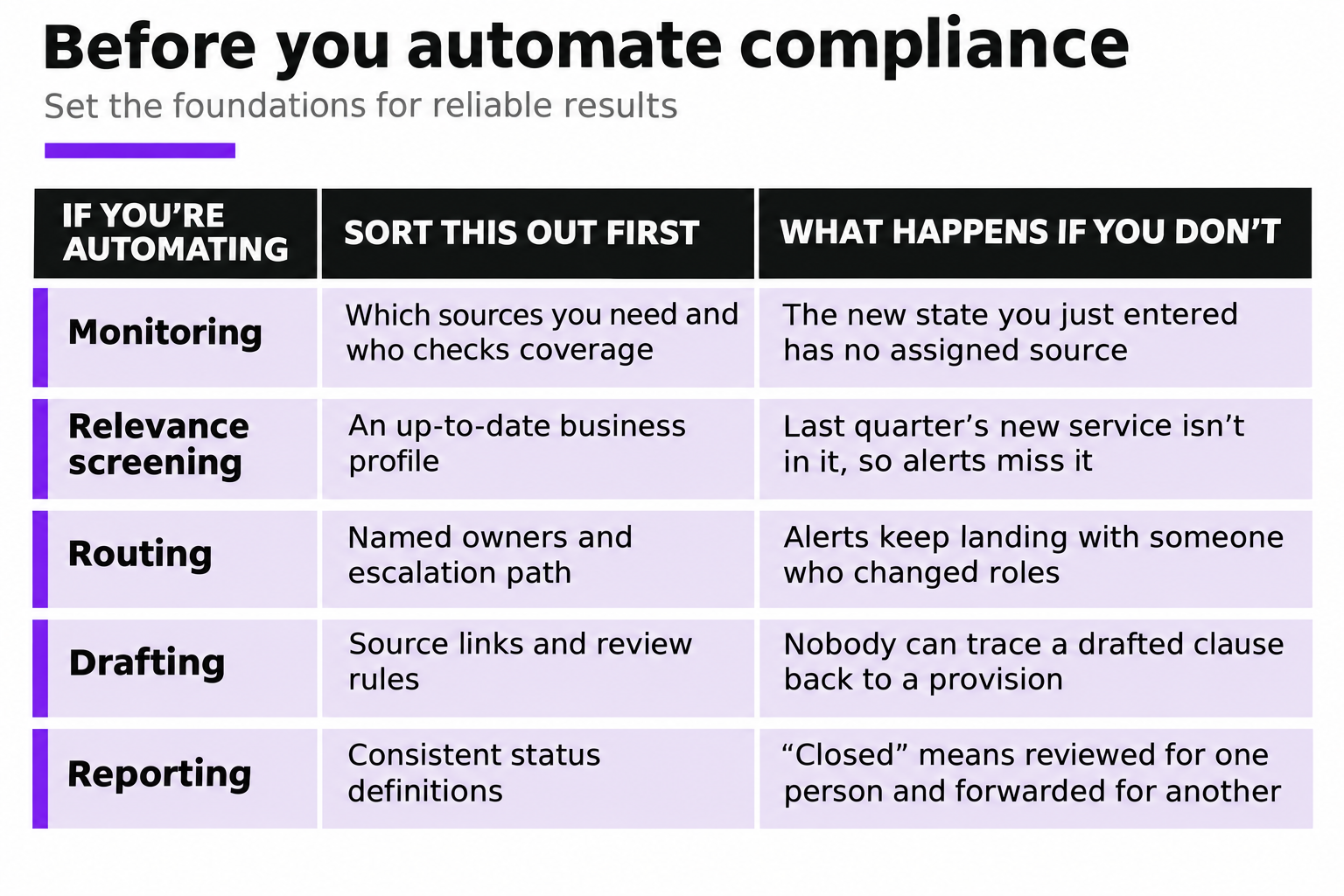
Clean inputs, clear owners, and a place for the output to land. Otherwise you get the same mess, faster.
If your team is still working mostly from spreadsheets, From Spreadsheet to Strategy is a practical place to start, especially for smaller teams.
Ambiguous interpretations, applicability exceptions, implementation choices, and final approval of policies and controls.
There are situations where even well-designed automation reaches the wrong conclusion. An alert scores a low relevance because it falls outside the documented business scope. But the company closed an acquisition last month, and the new entity’s activities haven’t been added to the profile. The alert matters and only someone who knows about the deal will catch it.
For AI-assisted work, decide who reviews output, how concerns get escalated, and when to stop the process. NIST’s voluntary AI Risk Management Framework covers documented roles and human oversight.
Regology’s AI Agents take on most of the six tasks.
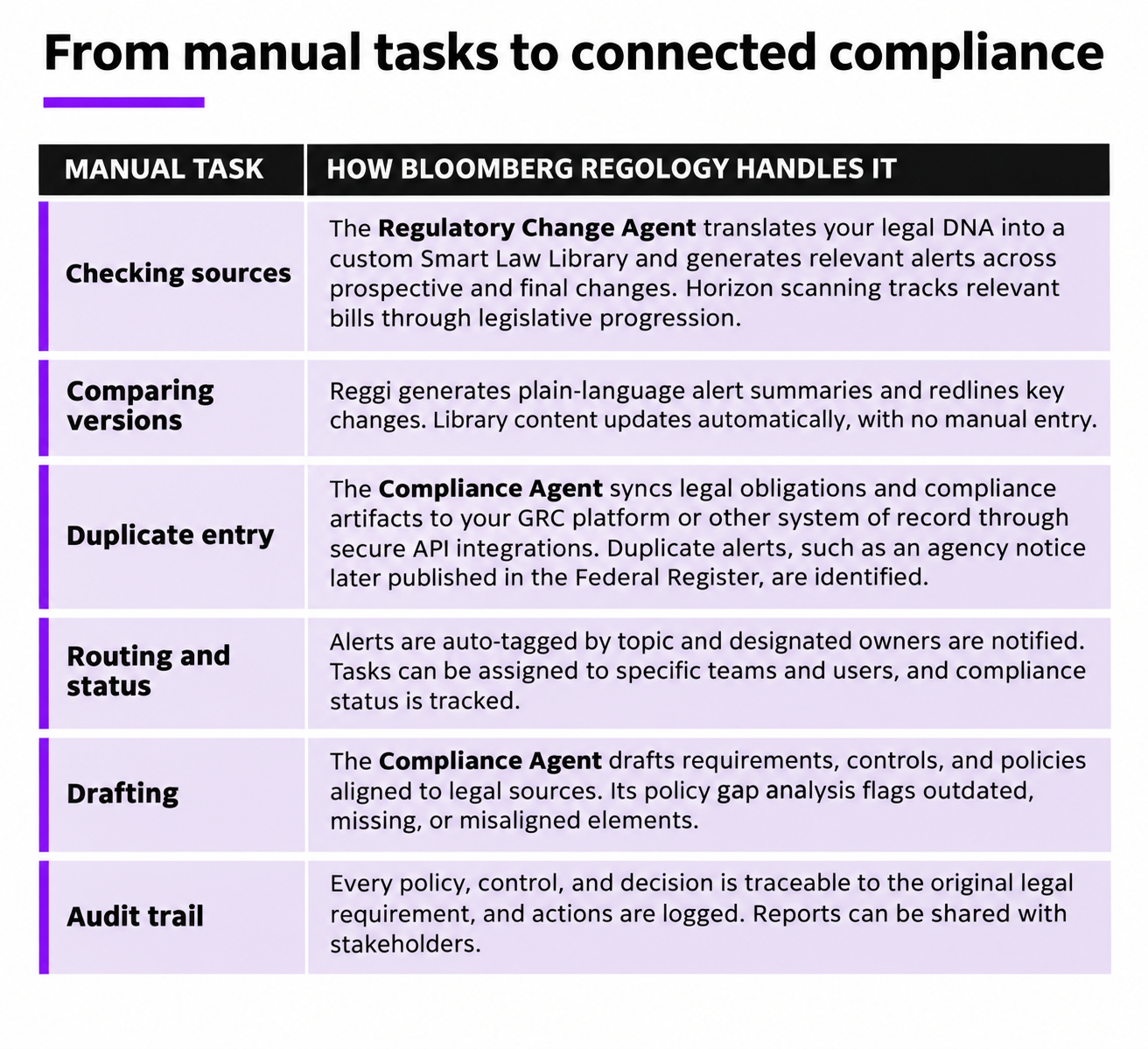
Your reviewers still make the calls described above. The way to judge fit is with your own workflow. Bring a recent update to a demo and see which steps drop out and what your team still needs to check. Request a Bloomberg Regology demo.
Start with a task that has clear inputs, repeatable rules, and a measurable outcome. For example, monitoring a defined set of sources or preparing version comparisons. Give it an owner and check the output before widening the scope.
No. Relevance scoring and preliminary analysis can narrow the review workload, but they do not eliminate the need for judgment
No. Routing rules, reminders, integrations, and reporting cut a lot of manual work without generative AI. Use AI where the task calls for it.
Compare the whole process before and after, including prep, review, correction, reconciliation, and maintenance. Make sure coverage and evidence quality hold up too.


Regology has been acquired by Bloomberg Industry Group, combining leading legal, tax and policy intelligence with regulatory AI.