

Back

A small dog sits on a red couch, looking towards the camera with its head tilted.](https://cdn.prod.website-files.com/663379b068243e81cd1bd4fd/667c15c9f851bf3b02bc3982_Overview.svg)


Back
industry


Back


Back


Compliance teams waste significant time reviewing alerts that never require action. Many are overwhelmed because most organizations fail to clearly identify which regulations apply to their business. When a compliance team doesn’t have an applicability guideline, every alert requires a manual review, resulting in teams spending valuable time determining if the alert matters or not. When your business does not clearly define applicability, every alert becomes a judgment call and almost nothing is safe to ignore.
· Regulatory noise is not just an alert-volume problem. It is an applicability problem.
· Irrelevant alerts still create work if the team cannot document why they do not apply.
· Better scoping helps legal and compliance teams separate signal from noise.
· The goal is not fewer alerts. The goal is defensible discussions about what applies, what does not, and who owns the next step.
Harvard Business Review has cited estimates that the average office worker receives around 121 emails a day. Regulatory alerts create a sharper version of the same problem. A higher volume, a thin context, and the cost of ignoring the wrong emails begs for a customized solution.
The noise can cost team time, confidence, and review capacity. The burden is not only reading too many alerts. It is the manual work required to decide whether each alert applies, can it be dismissed, or can it be defended later?
Keep in mind, an irrelevant alert is not free.
1. Someone has to open it.
2. Read it.
3. Compare it against the business.
4. Consider the jurisdiction.
5. Check the activity.
6. Decide whether the update can be ignored.
7. Document the decision.
If any of the above steps are ignored and the decision is not documented, the same question may come back later during an audit or an internal escalation. Regulatory alerts should never be treated as a volume problem. Better filtering may reduce the number of alerts, but filtering does not solve the biggest problem. Is this alert applicable?
For most organizations, the starting point is applicability scoping. Your legal and compliance team need a clear, defensible view of the regulations tied to your business needs. The guidelines must include business activities, products, jurisdictions, data types, customers, licenses, and thresholds. A lens that helps your teams separate the noise from the signal.
Imagine a cryptocurrency exchange that operates in the United States and receives an alert about new regulatory requirements affecting traditional securities broker-dealers. The alert comes from a prominent regulator and appears important because it relates to customer disclosures and transaction reporting. However, the exchange does not hold a broker-dealer license and does not offer the regulated activities covered by the rule. Without clearly documented applicability criteria, a compliance analyst may still need to review the alert, consult legal counsel, assess the firm's licenses and services, and document why the update does not apply. Across dozens of similar alerts each month, the time spent evaluating on applicable requirements can significantly reduce the team’s capacity to focus on regulatory changes that present actual compliance obligations.
Every alert should arrive with a clear explanation of why it matters for your business, and more importantly a context for your legal and compliance to make a decision. Regology is built around that shift and helps your team move from broad regulatory alerts to relevant updates shaped by your business context, applicability, source material, ownership, and traceability.
Generic regulatory feeds can identify regulatory changes, but without business-specific context they often cannot determine whether the changes are truly relevant to the organization. They may capture the right regulatory universe but without enough context about your activities, jurisdictions, products, data, licenses, and thresholds, too many updates arrive as “possibly relevant.” That sounds manageable until someone has to make the call.
A bank may receive an update about mortgage disclosures in three states. That alert may matter immediately to the retail lending team. It may not matter to the business lending team at all. But if the system cannot distinguish between those business lines, both teams will have to review it. The noise is not only the alert but the unnecessary applicability decision behind the alert.
Broad monitoring can tell you that something has changed, but legal and compliance teams also need business context to determine whether a change affects a specific entity, product, customer segment, or control environment. The false positives usually come from a few trigger categories.
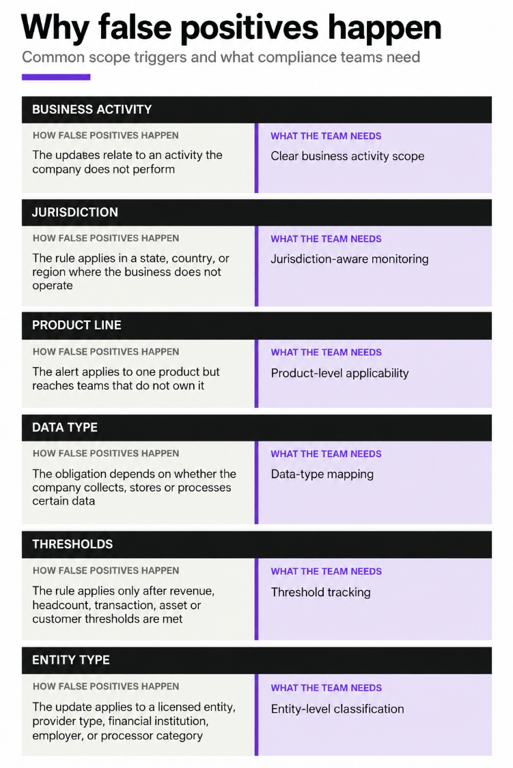
Organizations often focus on reducing the alert volume when the more effective approach is improving applicability. Teams may ask for fewer alerts, when what they really need is better scoping. If the system knows the company’s legal DNA, business profile, jurisdictions, and regulatory obligations, it can do more than send a broad update. It can help surface regulatory alerts that are easier to review route and document.
Regology’s Regulatory Change Agent is built around that idea, helping organizations evaluate regulatory changes through the lens of their business context.
The value is not only in reducing volume but helping legal and compliance teams realize, why an alert matters, who should review it, and whether it belongs in the workflow.
That distinction matters. A false positive consumes time, a false negative can create a risk. The objective is to connect regulatory change to business context early in the review process, helping teams reduce unnecessary reviews while identifying changes that require action.
Applicability scoping breaks because if and when the business changes, the scope generally remains frozen. Here are just a few of the changes that can impact applicability scope.
· A company enters a new state
· Launches a new product
· Adds a customer segment
· Collects new data
· Crosses a threshold
· Creates a new legal entity
Any one of the changes can affect which regulations apply. That is why applicability scoping cannot be treated as a one-time setup exercise.
Imagine a healthcare company operating in 5 states with regulatory alerts scoped to these 5 jurisdictions. Six months later the CEO announces expansion plans and opens up telehealth services in 3 more states. At first glance, the jurisdiction, the services, and its patient data practices will be evolving. If the legal and compliance teams do not update the scope or skip one, it can trigger the wrong alerts, reflecting the old footprint.
As the business evolves, gaps can emerge between actual operations and documented applicability criteria, increasing the risk of both missed obligations and unnecessary review.
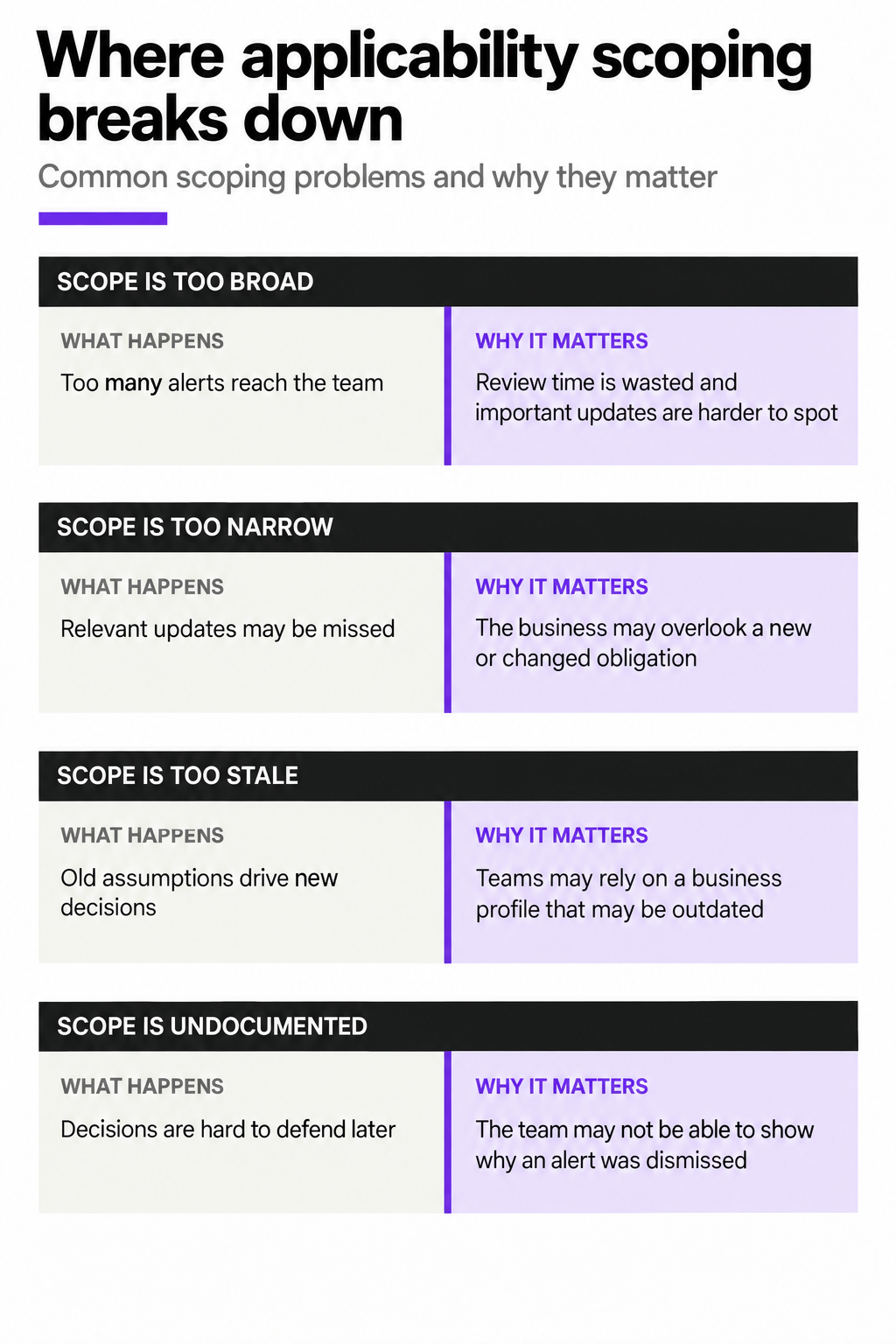
Whether applicability scoping is too broad or too narrow, decisions should be documented so teams can consistently demonstrate the rationale behind their reviews and dismissals. A better process treats applicability as a living model, where business context has to stay connected to regulatory change.
Regology’s Regulatory Change Agent seamlessly connects business context, relevant alerts, and regulatory change monitoring. For teams managing review and follow-up, Compliance Agent can tie regulatory updates to workflow, ownership, controls, policies and risks together.
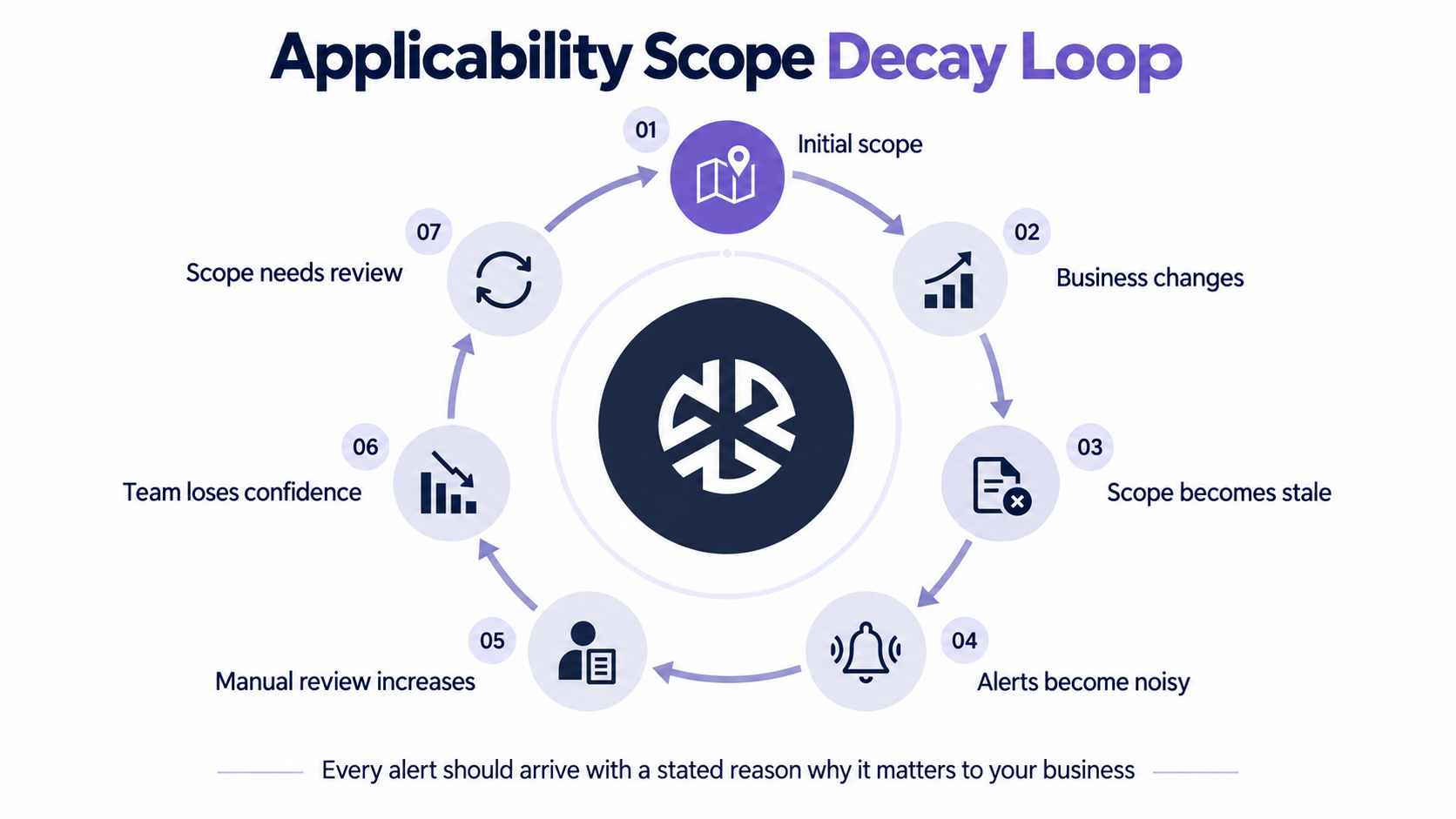
Compliance team can reduce manual review by using a regulatory intelligence workflow that links each update to business context, ownership, applicability, and documented decision-making. The goal is to make every alert explain itself, minimizing the hassles that may arise from a quick guess or a detailed read-through.
What good looks like: EVERY ALERT ARRIVES WITH A STATED REASON WHY IT MATTERS TO YOUR BUSINESS.
That one shift changes the work. Instead of asking, “Does this apply to us?” from scratch every time, the team can see why the update has surfaced. Regology’s Regulatory Change Agent helps legal, and compliance teams move from beyond alerts to business-specific guidance. Most importantly, it helps address applicability scope decay by keeping regulatory change connected to the business context as the organization evolves.
You know which regulations apply by ensuring a documented view of your business activities, jurisdictions, products, services, legal entities, data types, licenses and thresholds, is always current.
If those inputs are unclear, generic, or broad, alert review becomes guesswork. If they are documented, updated, and specific, the team can make faster and more defensible decisions.
Regology points to this data through a customer’s legal DNA, a Smart Law Library, and applicable regulatory change alerts. The value is not just receiving updates but updates that are embedded in your organization’s context.
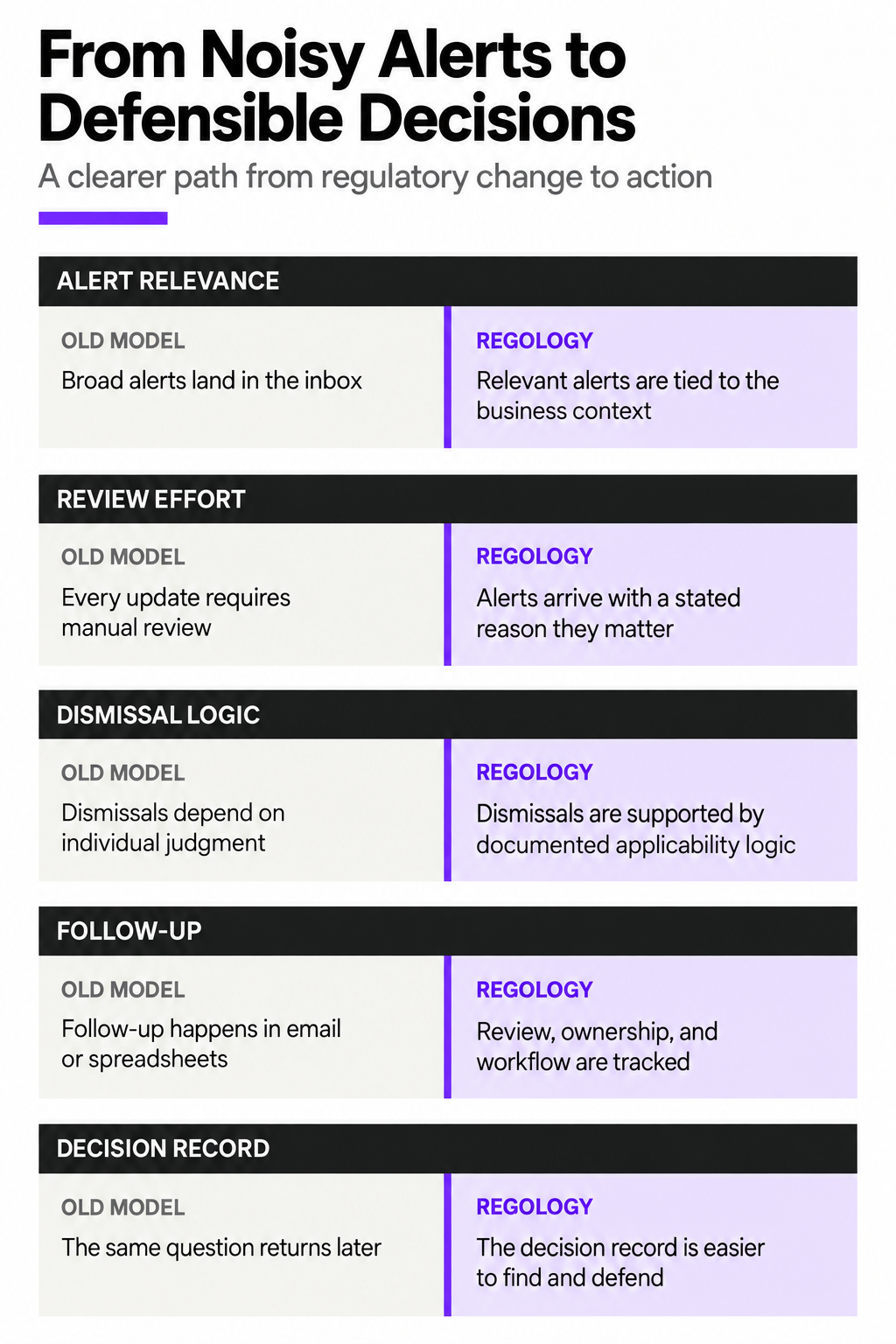
At minimum, teams should document:
1. The jurisdiction or regulator tied to the update
2. The business activity, product, service, or entity affected
3. The source material behind the alert
4. The reason why the alert applies or does not apply
5. The owner responsible for review
6. The action taken, dismissal rationale, or next step
Regulatory change work should not depend on memory. Bloomberg Regology helps turn review decisions into a repeatable record, so teams can spend less time re-answering the same applicability question and more time acting on the changes that matter.
See how Regology helps legal and compliance teams help with applicability scoping with source-linked, audit-ready workflows. Book a Demo
Applicability scoping is the process of defining which regulations apply to a business based on its activities, jurisdictions, products, services, data, licenses, entities, and thresholds.
Compliance teams often receive irrelevant alerts because the alerting process is too broad on its activities, jurisdictions, products, services, data, licenses, entities, and thresholds.
Regulatory noise is more than a filtering problem because an irrelevant alert still requires a decision. If the team cannot document why an alert does not apply, the alert continues to create work.
Teams can dismiss alerts with confidence when they have documented applicability criteria, source-linked reasoning, clear ownership, and a reviewable record of the decision.
Regology helps legal and compliance teams connect regulatory changes to business context, relevant alerts, workflow, ownership and traceability, creating a more consistent and traceable review process.



Regology has been acquired by Bloomberg Industry Group, combining leading legal, tax and policy intelligence with regulatory AI.