

Back

A small dog sits on a red couch, looking towards the camera with its head tilted.](https://cdn.prod.website-files.com/663379b068243e81cd1bd4fd/667c15c9f851bf3b02bc3982_Overview.svg)


Back
industry


Back


Back


General-purpose AI tools are useful for summarizing regulations, drafting explanations, and helping teams get up to speed quickly. The challenge begins after the answer is generated. Legal and compliance teams still need to verify sources, determine whether a change applies to their business, assign responsibilities, document decisions, and track follow-up actions. That is where a regulatory intelligence platform like Bloomberg Regology serves a different purpose.
Legal and compliance teams are asking this question for a practical reason: AI answers are becoming the destination, rather than the starting point. For most compliance teams, the real workload begins after an update is identified. Someone must determine relevance, assess impact, assign ownership, document decisions, and maintain a record of review. Those activities often matter more than generating the initial summary.
In a recent study, Pew Research Center found that when Google users saw an AI-generated summary, very few clicked on the cited sources and only 1% clicked on the source cited inside the AI-generated response. Source: Pew Research Center July 22, 2025
This statistic creates a real concern for regulated organizations. If legal and compliance teams accept the AI-generated answer without checking the underlying source, the risk is not just a bad summary. The risk is acting on information that may be incomplete, outdated, uncited, or disconnected from business context.
Imagine a compliance manager at a bank reviewing a CFPB update, a healthcare company tracking state privacy laws, or a cryptocurrency exchange monitoring evolving digital asset regulations. In each case, the question is not simply “What changed?” It’s also “Does this apply to us?” “Who needs to review it?”, “What action do we need to take?”, and ultimately “Did we take the necessary action?.”
General-purpose AI tools can be useful when your team needs speed around language. Tools like ChatGPT, Claude, and others can help turn dense material into plain-English summaries, early drafts and review questions.
These uses can save time when the output is reviewed by a legal or compliance professional. The issue is role clarity. These tools can support the work, but they do not replace the legal and compliance judgment needed to verify sources, assess applicability, and decide what happens next.
While general-purpose AI helps teams understand information, Bloomberg Regology helps them stay on top of regulatory change, determine what matters to their business, and manage the work that follows.
Compliance professionals rarely struggle because they cannot read the regulations. The challenge is determining what changed, whether the change is relevant, who needs to review it, and how to document the decision. Those steps often require legal sources, reviewing redlines, business context, ownership, and an audit trail, not just a well-written summary.
This is why general-purpose AI tools can create risks if they are used beyond their proper role. An answer may be clear, but it can still be incomplete, outdated, uncited, or disconnected from business context that matters. This is also consistent with broader AI risk guidance, which emphasizes governance, accountability, and managing the risk of AI outputs.
A compliance manager reviewing dozens of regulatory alerts each week does not need another summary. They need confidence that the update is relevant, visibility into who is reviewing it, and documentation showing what decisions were made. Those operational requirements are often what separate regulatory intelligence from general-purpose AI.
Bloomberg Regology helps bridge the gap between regulatory information and regulatory action by providing the context, workflow, and traceability needed to manage change effectively.
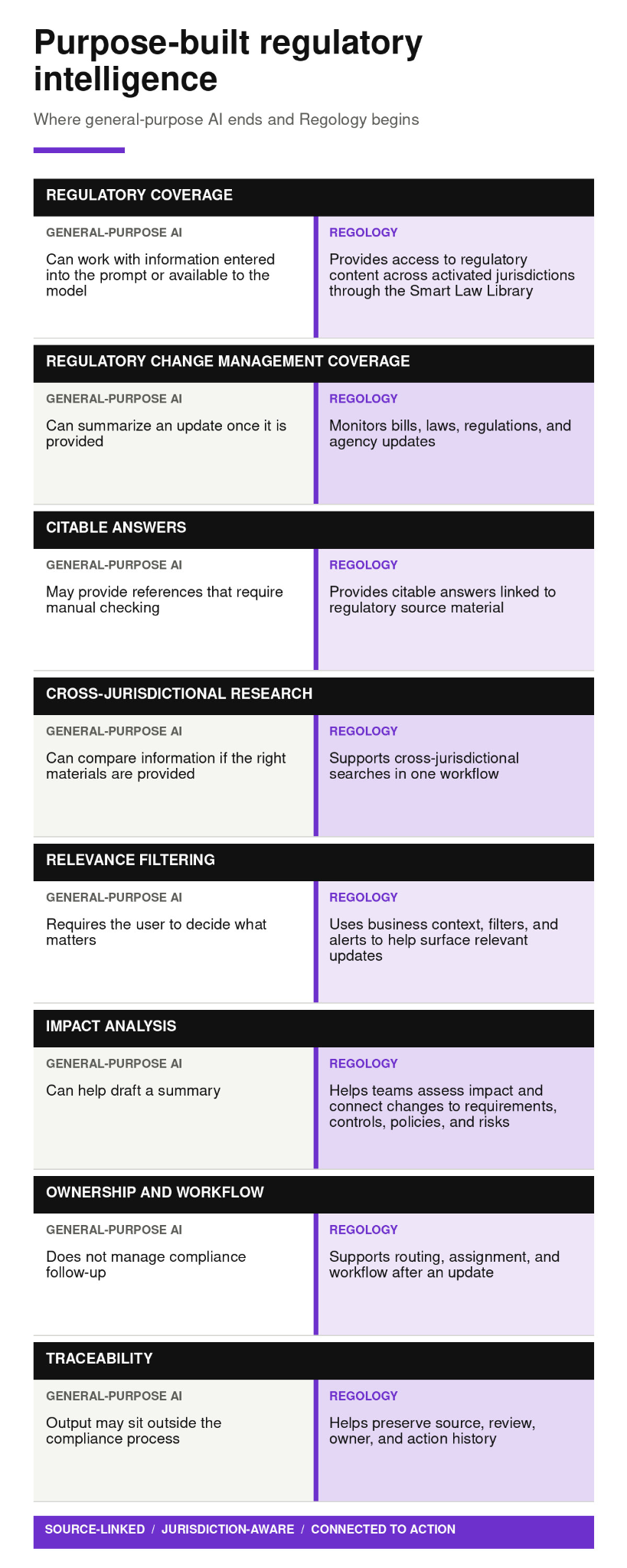
Use general-purpose AI when you need help drafting, summarizing or exploring. Use Bloomberg Regology when your team needs source-linked regulatory intelligence that can be monitored, applied, assigned, and reviewed. This is also where workflow features matter: reducing duplicate alerts, tagging updates by topic, and helping teams manage regulatory changes efficiently.
After a general-purpose AI tool gives your team an answer, the next question is whether that response can move into review, ownership, and action. This is where Bloomberg Regology serves a different role.
A summary may help at the start of the process, but regulatory work continues after the answer appears. Your team still needs to determine business impact and decide what action should be taken. In many organizations, finding regulatory information is not the bottleneck. Deciding what to do with it is.
Bloomberg Regology is designed around the work that happens after an update is identified. Teams can review what changed, determine whether it matters to their organization, assign follow-up tasks, and maintain a clear record of decisions. The goal is to turn regulatory information into an actionable process rather than another item sitting in the inbox.
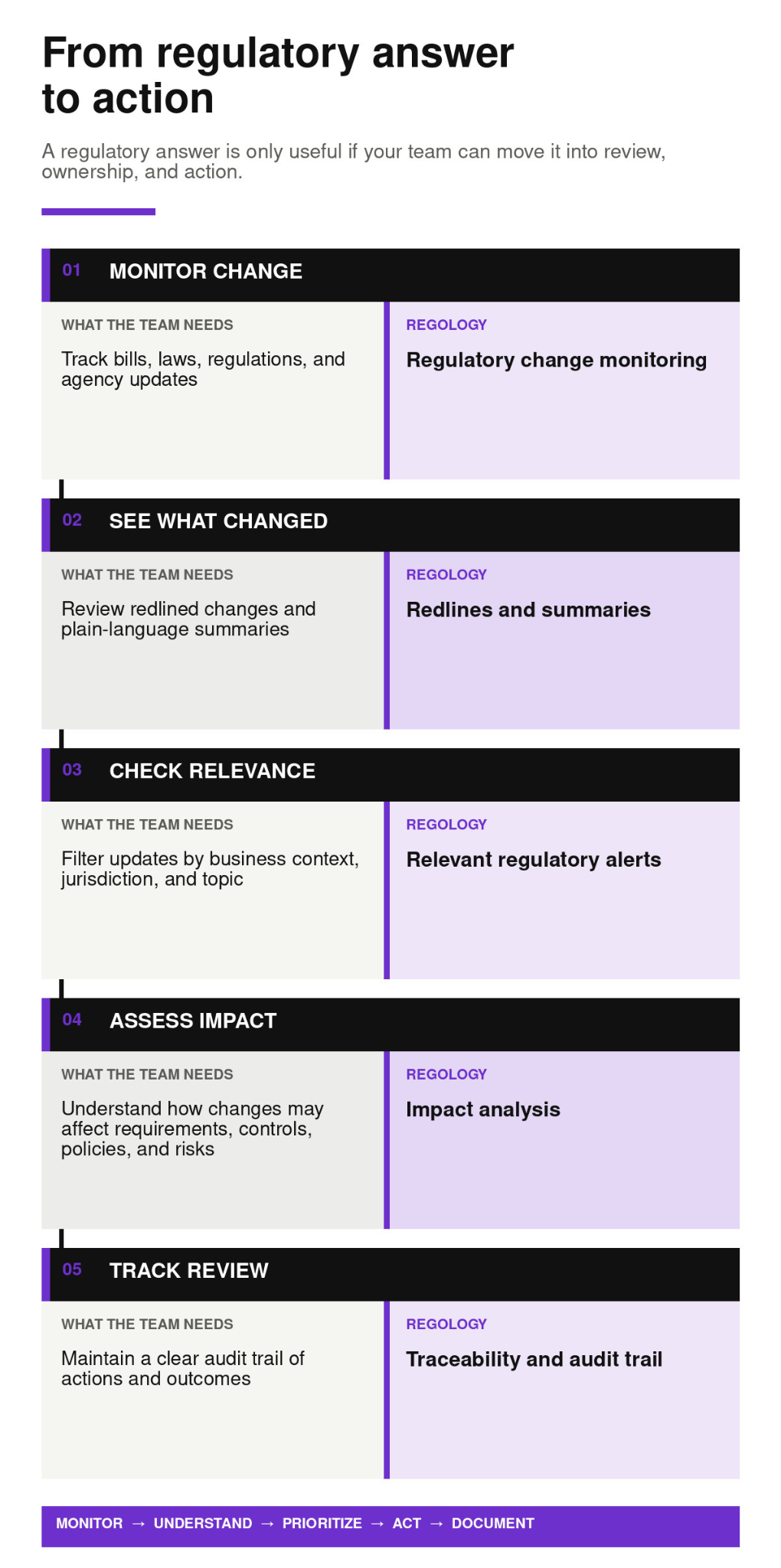
For regulated organizations, the burden is often the manual work that follows an update: filtering noise, debating applicability, routing work, and keeping a clear record. Bloomberg Regology helps turn that work into a repeatable process.
Use the decision point as a practical test: If the task ends with a draft, summary, or internal explanation, a general-purpose AI tool may be enough. If the task requires horizon scanning, current monitoring, applicability review, ownership, or documentation, legal and compliance teams need a purpose-built regulatory intelligence platform like Bloomberg Regology.
For business leaders, the distinction is practical. A team that relies on screenshots, email chains, spreadsheets, and disconnected AI outputs often spends more time validating information than responding to it. A structured regulatory intelligence process helps the team focus on decisions and action rather than administrative work.
Yes, general-purpose AI tools can support compliance work by helping teams summarize, draft, and organize information. The output should still be reviewed and verified before it is used in legal or compliance work.
The risk is relying on an answer that may be incomplete, outdated, uncited, or not applicable to your business. Compliance teams need to verify the source, jurisdiction, and relevance of information before acting.
Handling regulatory questions in separate AI chats can create information silos, reducing visibility across the team, and making it more difficult to ensure consistent review and document decisions.
Citations help legal and compliance teams see where an answer came from, review the underlying source, and support future documentation.
AI search responds to a prompt. Regulatory monitoring tracks legal and regulatory changes over time so teams can review, prioritize, and act.
A team needs a regulatory intelligence platform when it must monitor change, determine relevance, assign a follow-up, connect updates to obligations or controls, and preserve a record of review.
See how BloombergRegology helps legal and compliance teams manage regulatory change with source-linked, audit-ready workflows. Book a Demo



Regology has been acquired by Bloomberg Industry Group, combining leading legal, tax and policy intelligence with regulatory AI.