


Back

A small dog sits on a red couch, looking towards the camera with its head tilted.](https://cdn.prod.website-files.com/663379b068243e81cd1bd4fd/667c15c9f851bf3b02bc3982_Overview.svg)


Back
industry


Back


Back


Regulatory change management usually breaks after the alert because finding an alert and acting on it are separate jobs. Once an alert lands, someone has to decide whether it applies, who owns the review, and which policies or controls or processes it touches, and record the decision so it can be explained later. When that work runs through emails and spreadsheets, the alert gets found but the change usually goes unmanaged.
A post-alert workflow is everything that happens between, “we found a regulatory update” and “we can show what we did about it.” It covers source review, applicability, ownership, impact assessment, action tracking and the record that ties them together.
Most teams have a monitoring process. Fewer have a defined post-alert process. Regology’s Ultimate Regulatory Change Management Q&A Guide covers the full discipline. This article covers one stretch of it: the handoff after the alert is found.
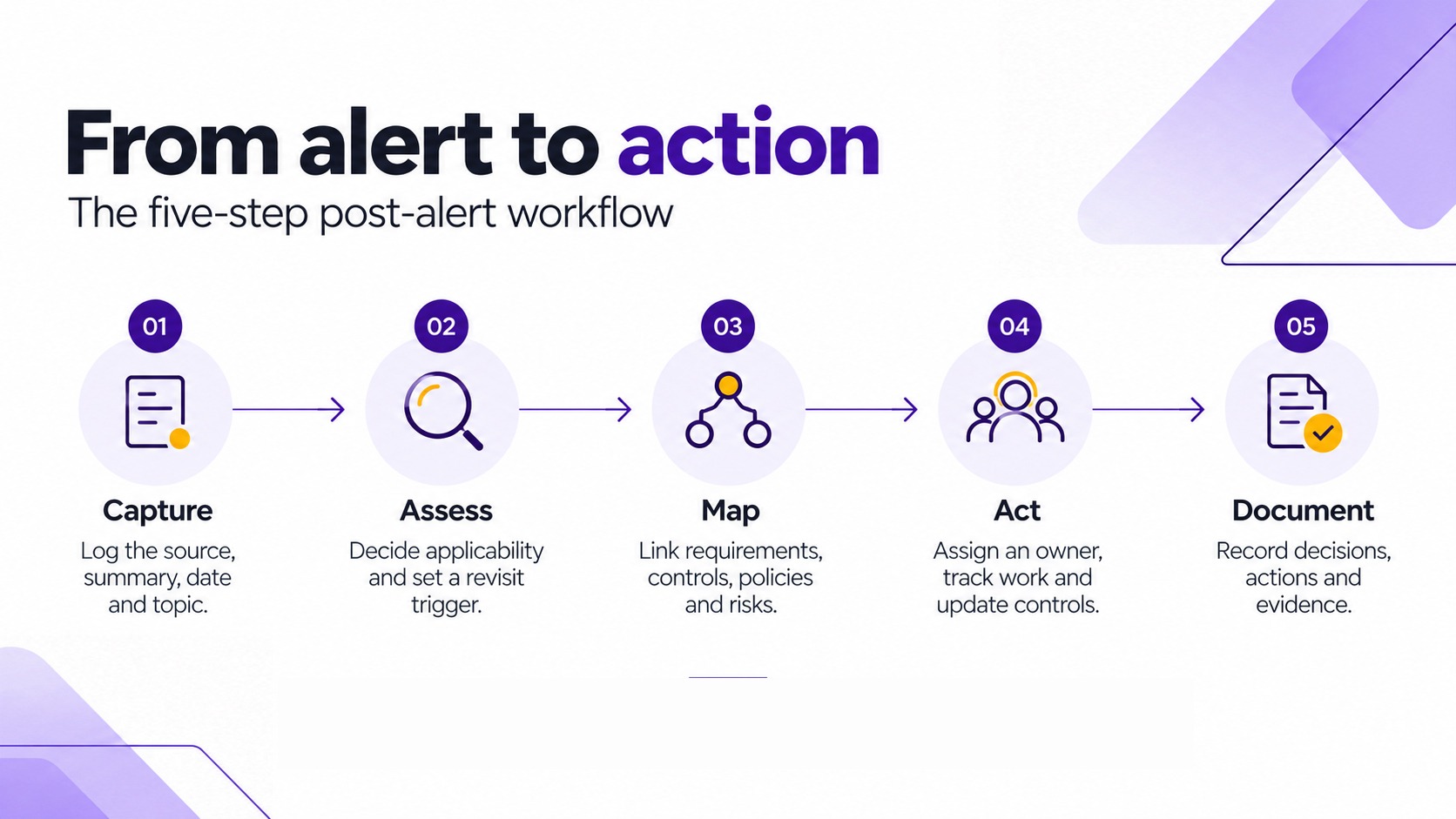
Here is a typical example from a typical organization dealing with compliance alerts.
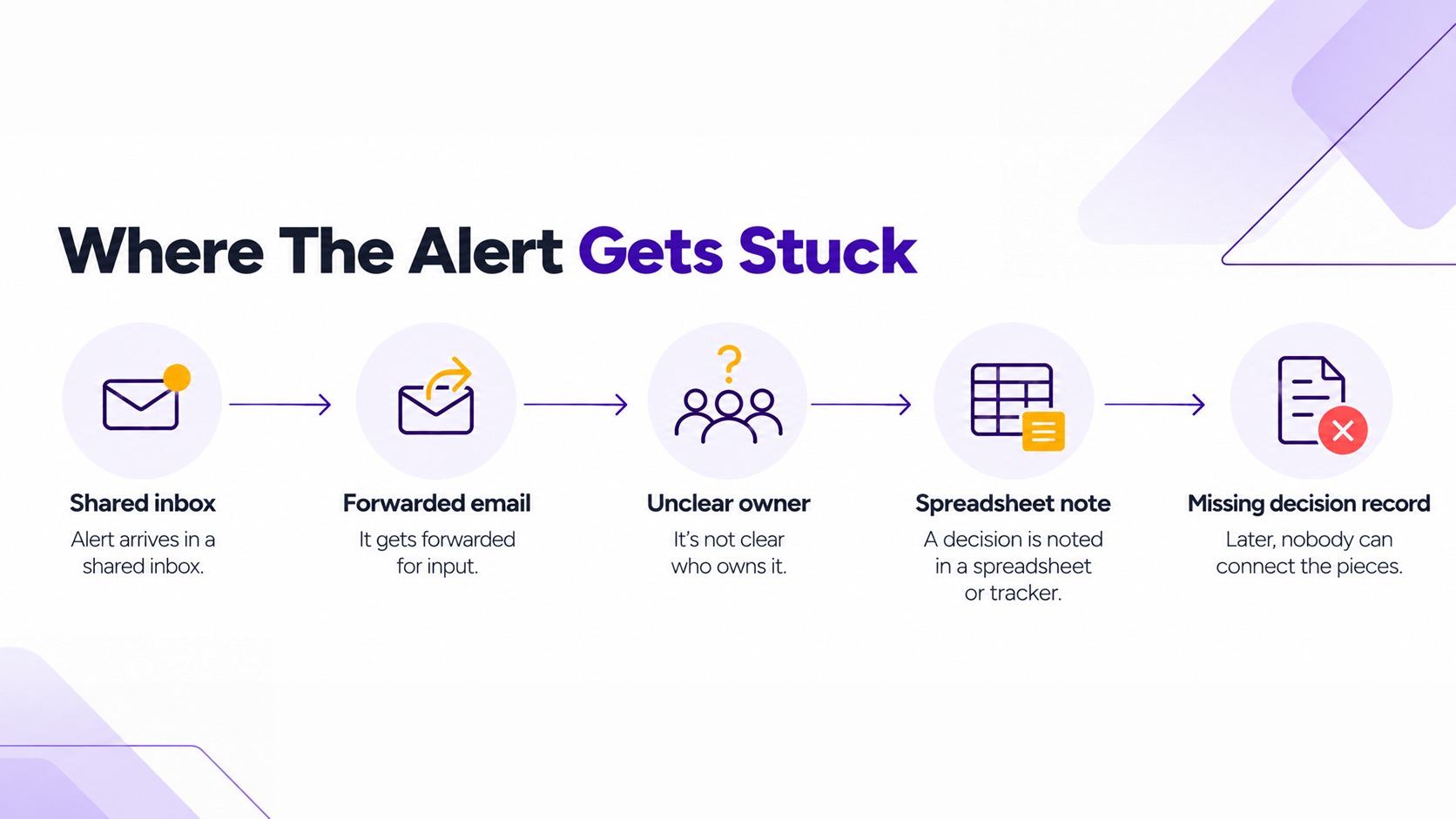
Monday, a state regulator publishes an amendment that may affect customer disclosures. It lands in the compliance team’s shared inbox.
Tuesday, an analyst forwards it to legal with “FYI. Does this affect us?”
Wednesday, legal replies that the disclosure language probably needs a look and asks whether compliance or product owns it.
Thursday, product asks whether the disclosure appears in the app or only on the website. Marketing asks whether the current copy should stay live in the meantime.
Friday, five people have touched the alert. Nobody has been assigned. Nobody has written down whether it applies. The thread goes quiet. Even though everyone responded, the process just had no place to put the work.
It breaks in a few predictable places, five to be exact. Each one is described below with the question your team should be able to answer.
1. Who owns the alert?
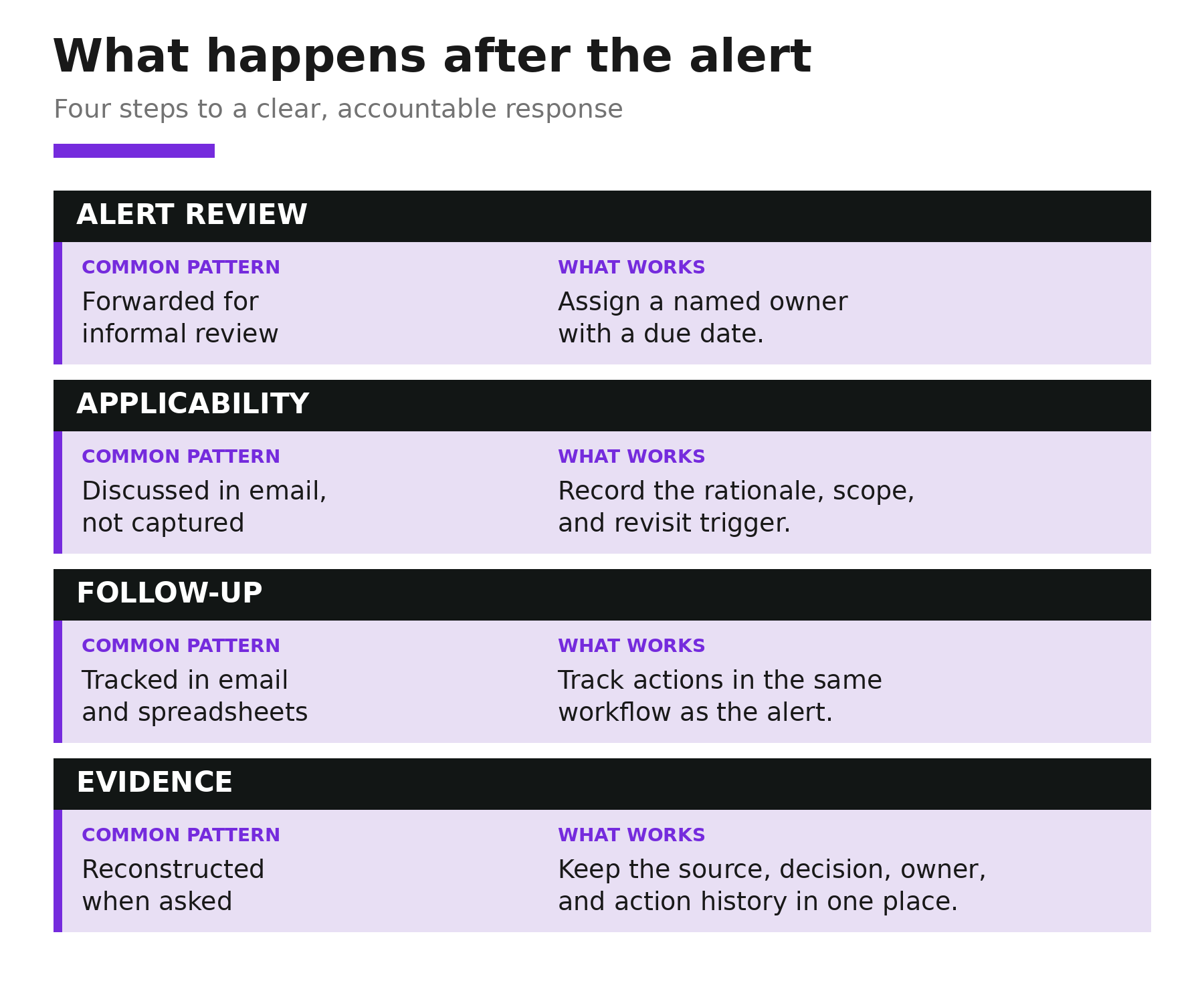
One person should be named and held accountable for moving relevant alerts to decision. That person doesn’t have to do all the work but they make sure it gets done and closed.
Ownership gets fuzzy when an update crosses teams. Legal reads the source. Compliance runs the program. Product owns the affected feature. Operations implement the change. Risk keeps the register. All of them have a role, and none of them assume they’re the one who should push it forward.
The roadmap for an effective and seamless regulatory change management is simple: an owner, a status, a next step, and a due date. If an alert has been open for two weeks without any of the four, it is stuck.
2. Does the change apply, and can you prove why?
The decision is often right, but the rationale is usually missing. Here’s the usual pattern. Someone reads the update and says it probably doesn’t apply. A colleague agrees in a reply. The alert is closed. Six months later the same question comes up in an internal review or an exam, and nobody can say why it was dismissed.
Applicability rarely comes down to a yes or no for the whole company. A rule may apply in one state and not another, to one legal entity and not the parent, or only above a revenue or a customer threshold. A privacy obligation can depend on whether you collect, sell, share or store a specific category of data. The record has to capture which of those facts drove the call.
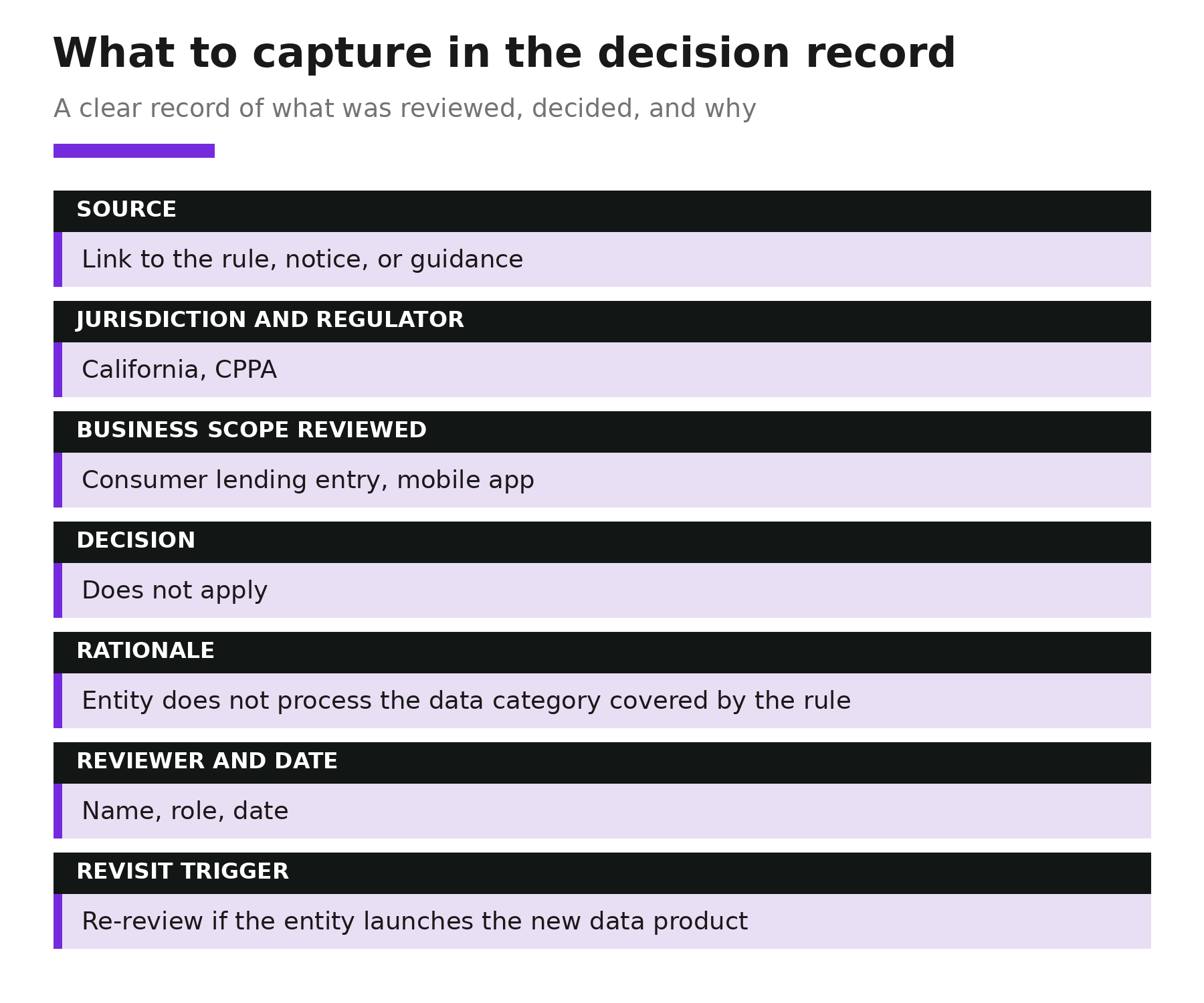
The revisit trigger is the field most teams skip. It is what keeps a “no” from going stale. For teams buried in volume before they even reach applicability. Making Sense of the Noise: Staying Ahead of Compliance Changes covers the filtering side.
3. What does the change touch within the business?
A regulatory change matters to the extent it changes something you operate: a policy, a control, a risk rating, a training module, a customer disclosure, system logic, or a regulatory report. If the alert isn’t tied to one of those, the team knows something changed but not what to fix.
Take a payments company that receives an alert about proposed changes to transaction monitoring expectations. Legal can summarize the proposal in an afternoon. The business still needs to know whether the current monitoring control holds up, whether the AML policy needs revision, whether the rule thresholds in the monitoring system need adjusting, and what evidence to keep in case the proposal becomes final.
A summary answers none of that and that’s why mapping the alert to the specific control and policy is crucial.
4. Where does the follow-up live?
Problems start when the alert, the decision, and the follow-up all live in different places. The alert sits in one tool, the decision sits in an email, and the policy change sits in a document repository with no link back to why it was made.
This is the spreadsheet problem, and the inbox problem, and the “I think Sarah handled it” problem. In the moment the work feels finished. Later, no one can connect the pieces.
The US Department of Justice’s Evaluation of Corporate Compliance Programs asks prosecutors to consider whether a compliance program works in practice, not only whether it is well designed on paper. A regulatory change process is judged the same way. Evidence of review and action counts, but simple awareness does not.
5. Can you rebuild the decision 6 months later?
If your team can't produce the full trail for a past alert within a day, the process has an evidence gap. That gap usually surfaces late, when someone outside the team asks.
The request can come from a regulator, an internal auditor, a board committee, or a new compliance lead who inherited the program. Rebuilding the answer means searching old emails, reopening spreadsheets, comparing policy versions, and tracking down people who may have left. Work that was already done, gets done twice.
The person asking will want to see:
If all six are in one place, the conversation takes ten minutes. If they’re scattered, it takes a week.
Answer yes or no for an alert your team closed in the last quarter.
1. Can you name who owned it?
2. Is the applicability rationale written down, including for a “Does not apply” decision?
3. Is it linked to the policy, control, or risk it affected?
4. Were follow-up actions tracked in the same place as the alert?
5. Could you produce the full record within one business day?
6. Is there a defined trigger for rereviewing the decision?
Bloomberg Regology covers both ends of the handoff.
The Regulatory Change Agent handles monitoring and relevance. It uses your organization’s legal DNA and the Smart Law Library to filter regulatory changes down to the ones tied to your business, so fewer alerts arrive and more of them matter.
The Compliance Agent handles what comes next. It connects obligations to your requirements, controls, policies, and risks, and supports assignment, review, and traceability back to the source text.
If your team gets regulatory alerts and still manages the follow-up through email and spreadsheets, start by finding where the handoff breaks.
Read the webinar recap to see how a multi-state health system moved from targeted alerts to assigned policy updates and audit-ready reports, or request a Bloomberg Regology demo to see an alert move from source to owner to recorded decision.
Because finding the alert is only the first step. Teams still have to decide applicability, assign an owner, map the impact, document the decision, and track follow-up. When those steps are informal, the alert is seen but the change is never managed.
Regulatory monitoring identifies new or changed laws, rules and guidance. Regulatory change management is the process of deciding what those changes mean for your business, assigning ownership, updating policies and controls, and keeping a record of the decisions. Monitoring feeds change management. It doesn’t replace it.
One named person should be accountable for each relevant alert, usually in compliance or regulatory change. Legal, product, operations, and risk may all contribute, but a single owner keeps the review moving and makes sure it closes with a recorded decision.
Yes. A decision that a rule doesn’t apply is still a decision, and it is often the one questioned later. Record the source, the business scope reviewed, the reasoning, the reviewer, the date, and what would trigger a rereview.
A spreadsheet can track a small volume of alerts for a single jurisdiction. It struggles once alerts span multiple regulators, entities and teams, because decisions, follow-up and policy changes end up in separate places with no reliable link between them.
Regology filters regulatory change against your business context, then connects relevant alerts to owners, applicability reviews, controls, policies, and risks, with a traceable record back to the source.


Regology has been acquired by Bloomberg Industry Group, combining leading legal, tax and policy intelligence with regulatory AI.


