How Ready Is Your Compliance Team For Regulatory Change?
A compliance team is ready for regulatory change when it can monitor the right sources, identify which updates matter, assess applicability, assign ownership, document decisions, and adapt when the business changes. If any of these steps rely on scattered emails, manual judgement, or one person’s memory, readiness may be weaker than it looks.
Key Takeaways
· Compliance readiness is not just about receiving alerts. It is knowing what to monitor, what applies, who owns the review, and what happens next.
· Jurisdiction coverage matters because every new state, country, regulator, or operating footprint can change the monitoring burden.
· AI readiness depends on structured data, clear ownership, trusted sources, and review criteria.
· A compliance readiness score helps turn a vague concern into a practical conversation about gaps, priorities and next steps.
What does compliance readiness mean?
Compliance readiness means you have a working process for regulatory change, not just a list of alerts or policies. A ready team can connect regulatory updates to business context, decide whether an update applies, route it to the right person, and keep a record of the decision.
This matters because compliance pressure rarely arrives in a neat sequence. Imagine a compliance team at a Nevada-based gaming operator learns the business is launching a mobile product in several new states. Product is focused on release dates and growth. Compliance has to deliver which new gaming, age verification, privacy, and payment rules now apply. This is often when gaps become visible.
Similarly, a healthcare team may expand telehealth into a new state. A financial services team may launch a new product. A privacy team may begin handling a new category of customer data. Each change can affect what the organization needs to monitor, who needs to review it, and whether existing controls are still enough.
This is where the process moves from theory to practice. The question is not “Do we have a compliance process?” A better question is “Would our process still work if the business changed tomorrow?”
The U.S. Department of Justice’s guidance on evaluating corporate compliance programs emphasizes whether a compliance program is designed around the company’s actual risk profile and whether it works in practice. That same idea applies to regulatory change management: a process has to reflect the business as it actually operates, not as it looked when the process was first documented.
What should a compliance readiness score measure?
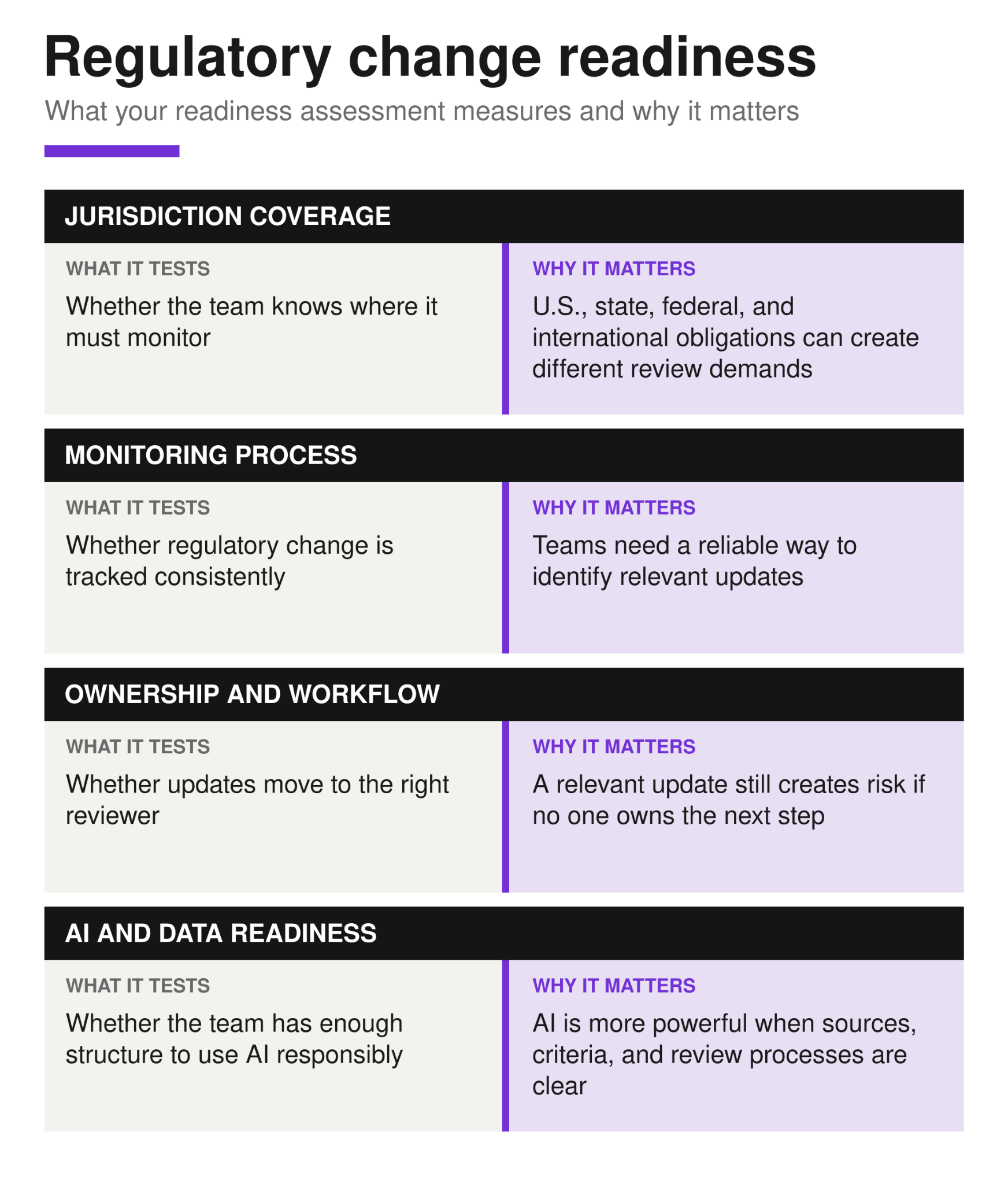
A compliance readiness score should measure whether the team can manage regulatory change across four practical areas: jurisdiction coverage, monitoring process, ownership workflow, and AI/Data readiness.
This article builds on Bloomberg’ Regology's broader Regulatory Change Management framework,The Ultimate Regulatory Change Management Q&A Guide. That guide addresses the larger discipline. This article focuses on a narrower question: how can a team quickly assess whether its current process is ready for regulatory change, jurisdiction complexity, and responsible AI adoption?
CHECK YOUR REGULATORY COMPLIANCE SCORE:
Answer a few questions to see where your regulatory monitoring process is strong, where it may be inconsistent, and what may need attention first.
Bloomberg Regology
Regulatory compliance readiness assessment
Compliance readiness calculator
How ready is your compliance team for regulatory change?
Answer five quick questions across four readiness areas to see where your regulatory monitoring process is strong, where it may be inconsistent, and what needs attention first.
About one minute0 of 5 answered
Please answer all five questions to calculate your score.
Your readiness result
Know where you stand. See what to improve.
Would your process still work if the business changed tomorrow? Check your jurisdiction coverage, monitoring process, ownership and workflow, and AI and data readiness.
/ 10 points
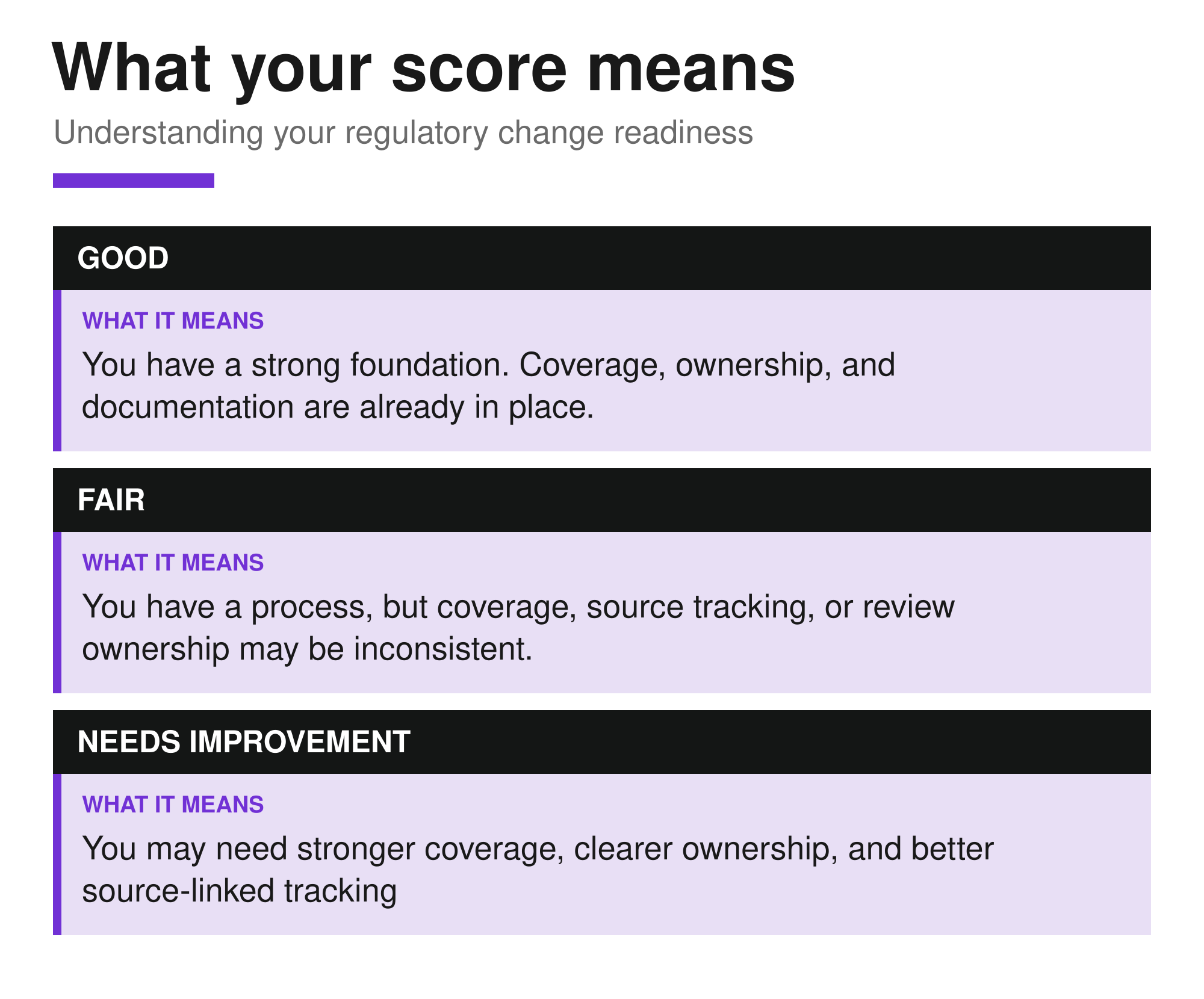
Good
Your result
Strong foundation
Your answers indicate a strong foundation. The next opportunity is handling more change with less manual effort.
Fair
Your result
Some gaps remain
Your process exists, but coverage, source tracking, or review ownership may be inconsistent.
Needs Improvement
Your result
Priority gaps to address
Strengthen coverage, clarify ownership, and connect decisions to their sources.
Your four readiness areas
Your next opportunity
Turn regulatory change into completed action.
Connect relevant changes to requirements, owners, policies, and controls so your team can reduce manual work and keep the response moving.
Each answer earns 2 points for Yes, 1 for Partly, and 0 for No. All five questions carry equal weight. Jurisdiction coverage has two questions (4 possible points); monitoring process, ownership and workflow, and AI and data readiness each have one (2 possible points each). Good: 9–10 points. Fair: 5–8 points. Needs Improvement: 0–4 points.
This is an indicative self-assessment, not a validated benchmark or a full compliance review. AI and data readiness checks trusted sources, clear criteria, and human review. It does not assess your full AI governance program or require that you already use AI.
Compliance readiness overview
Your answers
Assessment question
Your answer
Priority next steps
Scoring: Yes = 2, Partly = 1, No = 0. Good: 9–10; Fair: 5–8; Needs Improvement: 0–4. Indicative self-assessment, not a validated benchmark or a full compliance review. Explore how to put these next steps into practice: regology.com/request-a-demo
What is your compliance readiness score?
Your compliance and regulations score is a quick way to check whether your monitoring process is structured enough to keep up with change. The score is based on practical readiness signals: whether you track changes across jurisdictions, know which rules apply to your business, have one source of truth for updates, and can show source and citation history.
The assessment takes less than a minute or so to complete. It is not meant to replace a full compliance review. It is meant to surface the kind of gaps that often hide inside day-to-day regulatory work.
For example, a team may believe its monitoring process is working because alerts are being received. But if updates are spread across emails, spreadsheets, outside counsel notes, and separate team trackers, the process may still be difficult to explain. Another team may know which regulator matters the most but not have a clean way to show why a specific rule applies to one part of the business and not another.
The score helps by turning readiness into a concrete discussion about what’s working, what’s only partly covered, and what needs attention first.
What does your compliance readiness score mean?
The tool returns one of the three results.
A Needs Improvement score usually means that the team may be relying too heavily on manual tracking, unclear ownership, incomplete jurisdiction scope, or disconnected source material. This is the risk zone, not because your team is careless, but because the process may require too much manual effort to defend decisions.
Meanwhile, a Fair score usually means your organization has a process, but parts of it may be inconsistent. This is where many teams sit in real life. The message is not that your process is broken. It’s that your team may be ready for a more structured regulatory intelligence workflow. A free Regology demo can give you a clearer picture of how to move forward and make improvements.
Which Readiness gaps hold compliance teams back?
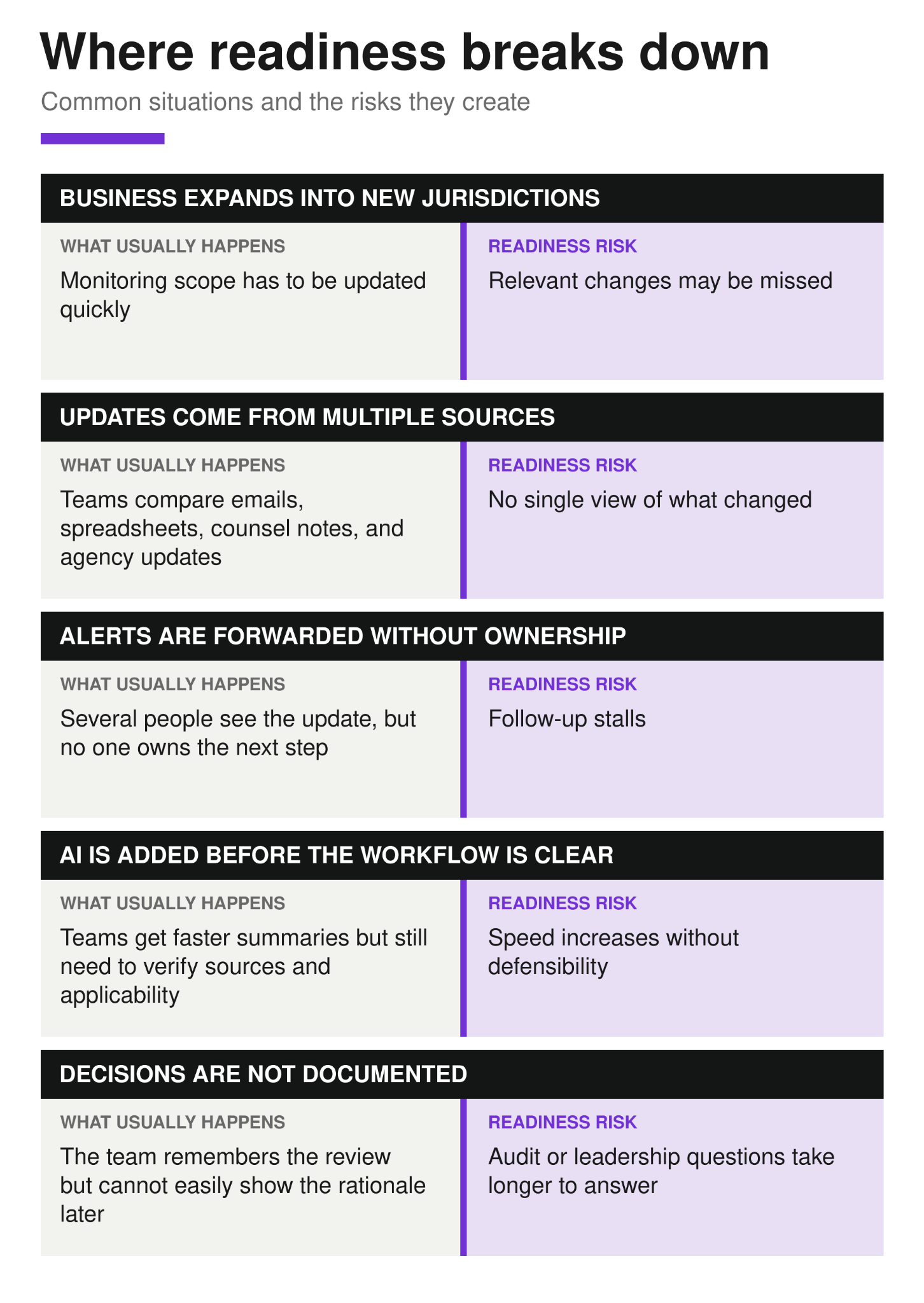
The most common readiness gaps are unclear jurisdiction coverage, inconsistent monitoring, weak ownership, and scattered data. These gaps often stay hidden until the business expands, regulatory volume increases, or leadership asks for a clear view of what has changed.
Gap 1: The team is not clear on which jurisdictions to monitor.
Jurisdiction coverage is one of the first places readiness breaks down. A team may know its home regulator well but struggle to keep up when the business expands to other U.S. states, federal agencies, or international markets.
A company does not need to be global for this to become difficult. A healthcare provider offering telehealth across state lines, a fintech expanding lending products, a web-based gaming operator launching in new states can quickly move from one clear regulatory footprint to a much more complicated monitoring map.
Ask yourself: Can your legal and compliance team explain which jurisdictions matter and why?
Gap 2: Monitoring depends on too many disconnected sources.
Many teams do not have a single monitoring process. They have a mix of agency emails, outside counsel, updates, trade association notes, spreadsheets, legacy systems, internal chats, and manual searches. That can work for a while but it becomes harder when the volume increases or when more teams need to act on the same update.
Ask yourself: Does your team have a single source that has a complete and current view?
Regology’s regulatory Change Agent supports regulatory change monitoring through business context and relevant alerts rather than relying on disconnected streams of information.
Gap 3: Ownership is unclear after an update is found.
A regulatory update only creates value if the right person reviews it and decides what happens next. In many organizations that step is informal. One person forwards an alert. Another comments in a spreadsheet. A third asks whether legal has reviewed it. Two weeks later, the team knows that an update was discussed, but not necessarily who owns the decision.
Clear workflow becomes critical at this stage.
Ask yourself: Is someone clearly responsible for reviewing, tracking, and documenting updates?
Gap 4: The team wants to use AI, but the process is not ready
AI can help legal and compliance teams work faster, but only if the underlying process is structured enough to support it.
If regulatory updates are scattered, ownership is unclear, and review criteria are inconsistent, AI may amplify confusion instead of improving readiness. A summary is not enough if the team cannot verify the source, assess applicability or show how the decision was reviewed.
Ask yourself: Does your team have the sources, structure, and review process that would let AI be useful?
The National Institute of Standards and Technology’s AI Risk Management Framework emphasizes governance, measurement, management, and trustworthy practices.
Although the details differ, the underlying challenge is usually the same. Working harder is rarely the problem. The question is whether the process gives your team enough structure to keep up when regulatory change, business change, and AI adoption all move at the same time.
How can teams improve compliance readiness?
Most compliance teams improve their process by making regulatory changes easier to track, review, and act on. The goal is not to create more processes but to reduce uncertainty when something changes.
Start with the area where you score the lowest. If jurisdiction coverage is unclear, start by defining where the business operates and which regulators matter. If monitoring is scattered, centralize the sources and the review process. If ownership is unclear, define who reviews, who updates, and who decides what happens next. If AI readiness is low, organize the sources, criteria, and review steps before adding automation.
For many teams, the biggest shift is moving from informal knowledge to a working record. It is not enough for one person to know why an update matters. The organization needs a way to show what changed, why it was reviewed, who owned the decision, and what action followed.
Imagine walking into a quarterly risk meeting and being asked a simple question: “Are we covered?” A weak process answers with effort. A stronger process answers with evidence.
Bloomberg Regology can help legal and compliance teams by connecting regulatory monitoring, business context, applicability, workflow, ownership, and traceability in a more structured regulatory intelligence process.
Regology’s Regulatory Change Agent can support monitoring and relevant alerts shaped by the business profile. Regology’s Compliance Agent can help teams connect updates to ownership, workflows, controls, policies, and risks.
Check your compliance and regulations score, then use the result to identify what to fix first.
Compliance readiness is the ability to monitor regulatory change, understand what applies to the business, assign ownership, and document the decision or action that follows. A ready team does not just receive alerts. It has a process to turn regulatory change into reviewable action.
How do you measure compliance readiness?
You can measure compliance readiness by looking at four areas: jurisdiction coverage, monitoring process, ownership, workflow, and AI/data readiness. These areas show whether the team knows what to monitor, how updates are tracked, who owns follow-ups, and whether the process is structured enough to support responsible AI use.
Why does jurisdiction coverage matter?
Jurisdiction coverage matters because every state, country, regulator, or operating footprint can change what the business needs to monitor. A team that operates across multiple U.S. or international jurisdictions needs stronger scoping and routing than a team focused on one primary jurisdiction.
Why is AI readiness part of compliance readiness?
AI readiness is part of compliance readiness because AI depends on the quality of the underlying sources, data, and review process. If regulatory information is scattered or ownership is unclear, AI may produce faster summaries without making the decision more defensible.
How can Bloomberg Regology help improve compliance readiness?
Regology helps legal and compliance teams connect regulatory change to business context, relevant alerts, applicability review, ownership, workflow, and traceability.
Ready to Learn More?
We would be happy to discuss your regulatory compliance needs. Contact our leading team of experts today.



A small dog sits on a red couch, looking towards the camera with its head tilted.](https://cdn.prod.website-files.com/663379b068243e81cd1bd4fd/667c15c9f851bf3b02bc3982_Overview.svg)